Transit testing asks whether the finished beauty product can tolerate the handling conditions expected between factory and customer. It should evaluate the complete pack system: primary container, closure, decoration, insert, retail carton, inner case and shipper.
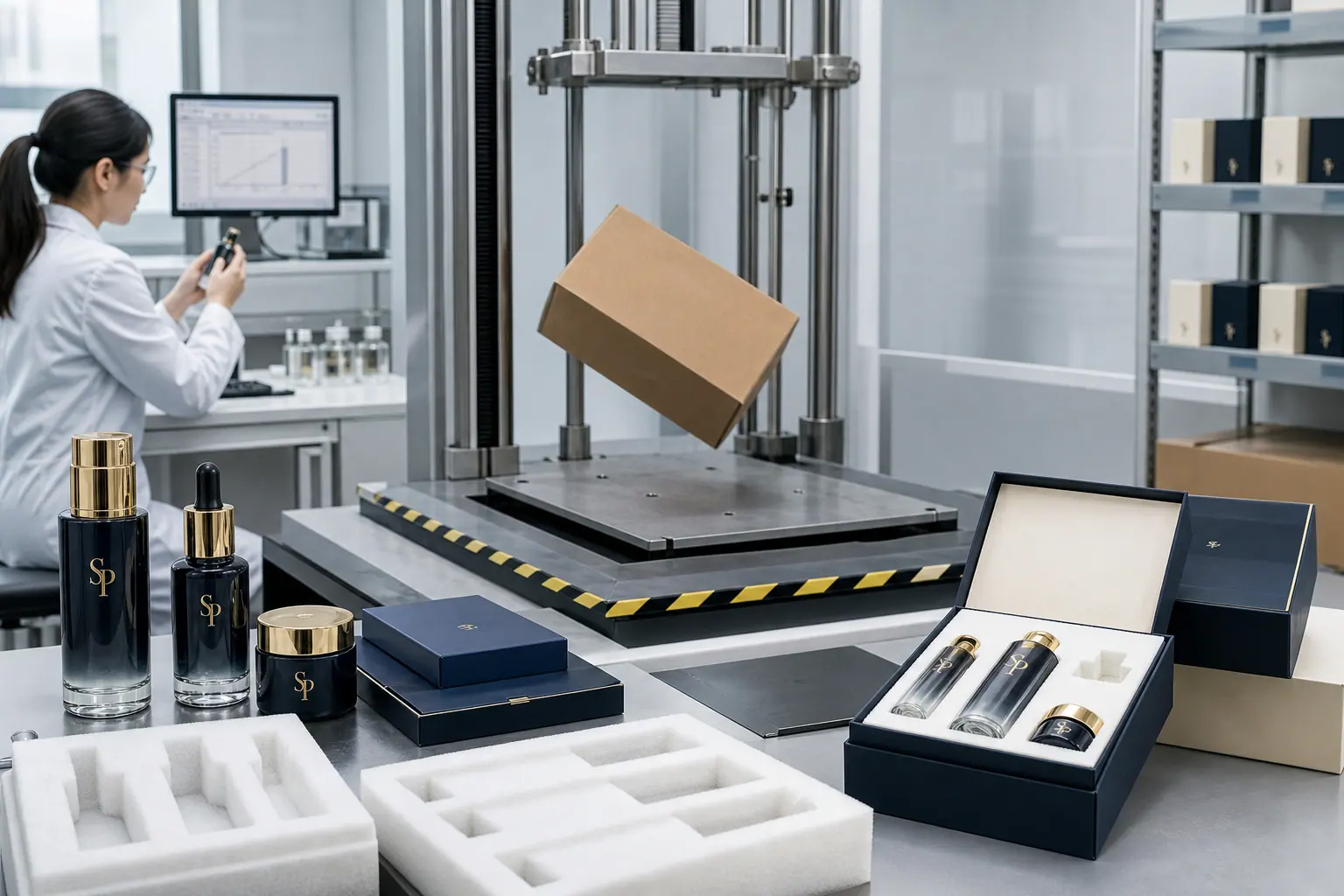
Start with the distribution route
A pallet delivered to a distributor faces a different journey from an ecommerce parcel shipped as a single unit. Before selecting a test, map likely transport modes, handling stages, climate exposure, case orientation and whether units will be removed from the master carton.
What a practical test plan may consider
- Drop or impact events at defined orientations.
- Vibration associated with transport.
- Compression from stacking and storage.
- Temperature or humidity conditioning when relevant.
- Leakage, breakage, scuffing and carton deformation.
- Product presentation after the pack is opened.
The exact method and acceptance criteria should be selected for the product, route and market. A glass fragrance bottle, pump lotion and soft tube do not share the same failure modes.
Use production-representative packs
A hand-cut insert or undecorated bottle may help early development, but final verification should reflect production materials and assembly. Coating, label adhesion, carton board, closure torque and divider fit can all influence the result.
Define failure before testing
Obvious breakage is a failure, but brands should also decide how to treat leakage, pump damage, cosmetic scuffing, crushed corners and movement inside the insert. Separating functional, safety-related and appearance observations makes decisions clearer.
A simple inspection sequence
- Photograph and inspect the packs before testing.
- Record component, formula and assembly versions.
- Run the agreed conditioning and handling sequence.
- Inspect without immediately cleaning or resetting the pack.
- Record location, frequency and severity of findings.
- Open representative units and check dispensing and appearance.
Testing is not a substitute for packing discipline
Even a well-designed carton can fail if cases are under-filled, dividers are reversed or pallet patterns change. Link the approved configuration to work instructions and the shipping-case and pallet plan.
Frequently asked questions
Does every cosmetic product need the same drop height?
No. Test conditions should reflect the selected method, pack weight, distribution route and project requirements.
Can a brand test only the retail carton?
That may answer a narrow question, but it does not represent the protection provided by the complete shipping configuration.
When should transit testing be repeated?
Consider a review when the primary pack, insert, carton material, shipper, pallet pattern or distribution route changes.
For glass bottles and coordinated secondary packs, explore SHANGPIN LAB packaging or send your pack brief.