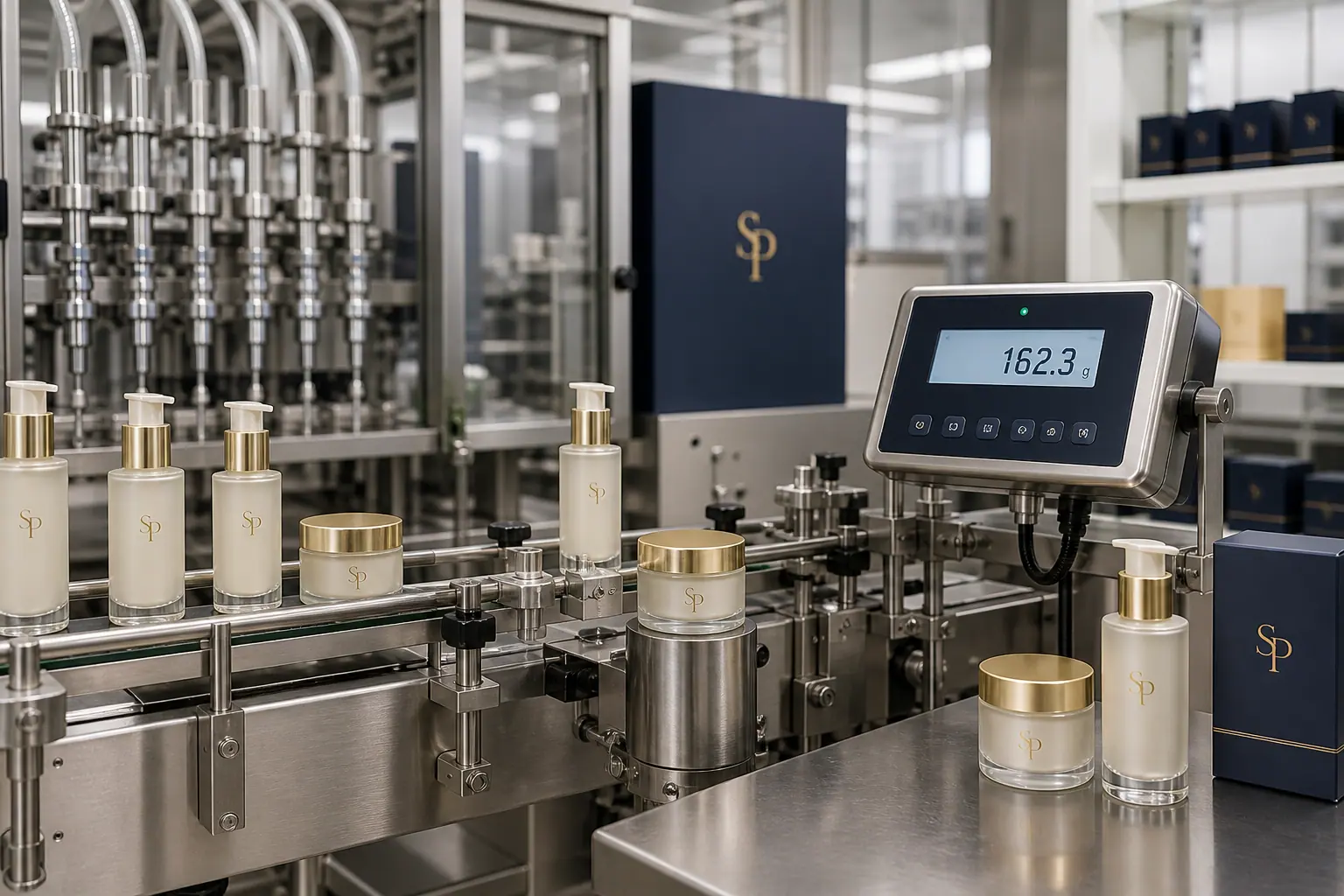
Fill weight and declared volume are related, but they are not interchangeable. A cosmetic product may be sold by volume while the filling line controls the dose by weight. The bridge between those two values is the formula’s measured density, together with the dispensing and inspection method agreed for the project.
Why brands should resolve the question before bulk production
A 50 mL lotion does not automatically weigh 50 g. Density can change with formula composition, temperature and entrained air. Packaging also retains a small amount of product that may not be dispensed by the consumer. If the brand brief mentions only one number, the factory may still need several controlled values to set up and verify the line.
The five values to put in the production brief
- Label declaration: the net quantity that will appear on the approved artwork.
- Target fill: the operational set point used during filling.
- Acceptable range: the agreed upper and lower limits for in-process checks.
- Density reference: the test method, temperature and approved formula version.
- Package tare: the empty component weight and the method for handling normal component variation.
These values should be linked to the approved formula, component code and batch record. A change in bottle, pump or formula may justify another review rather than an automatic carry-over.
Weight-controlled filling versus volume-controlled filling
Weight control is useful because scales are easy to verify and digital records can be reviewed. Volume-controlled equipment can be appropriate for other formats. The practical question is not which method is universally better; it is whether the selected method is suitable for the formula’s flow, the pack geometry, the line speed and the agreed inspection plan.
Questions to ask during line setup
- Is the product filled warm, ambient or after a defined hold?
- Can air bubbles or foaming affect the first readings?
- How often are in-process samples checked?
- How is container tare variation handled?
- What happens when a reading falls outside the agreed range?
Do not confuse filled quantity with usable delivery
A correctly filled pack can still deliver less product than expected if the dip tube, actuator, jar shoulder or airless mechanism retains material. For pumps and airless packs, brands can review priming, dose consistency and residual product as a separate packaging-performance question. This connects the filling brief with packaging selection and compatibility work.
A simple approval sequence
- Freeze the formula version and proposed pack.
- Measure density using an agreed method.
- Define label declaration, target and inspection range.
- Run filling and dispensing checks on representative components.
- Record the approved settings in the production documentation.
Frequently asked questions
Can a brand convert grams to millilitres using a generic online calculator?
Not reliably for production. The calculation should use the measured density of the approved formula under defined conditions.
Should every unit contain exactly the same weight?
Manufacturing processes have controlled variation. The relevant acceptance approach depends on the product, market, equipment and agreed specification.
When should the fill specification be reviewed again?
Review it when the formula, pack, filling condition or target market changes, or when line-trial evidence indicates that the previous setup is no longer representative.
Preparing a new filling project? Review SHANGPIN LAB’s manufacturing route or send a project brief with the formula format, pack size, target market and expected quantity.